

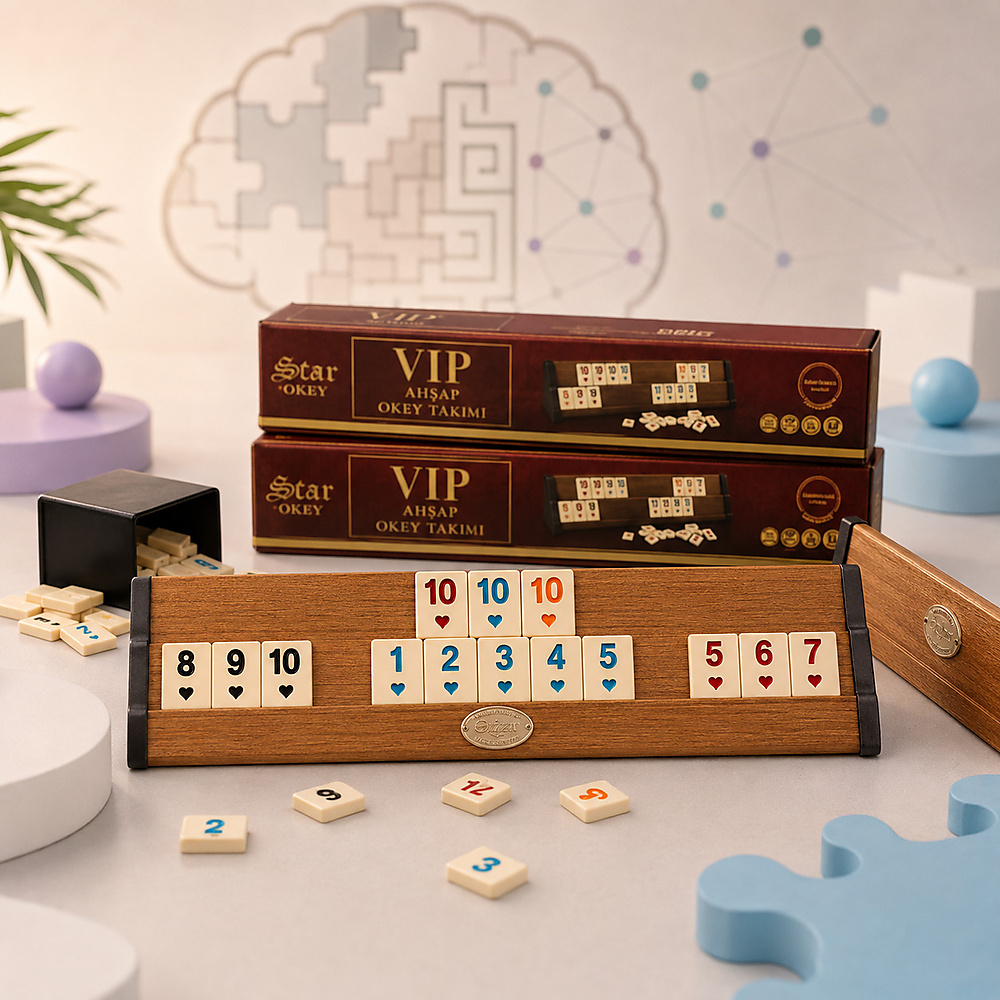

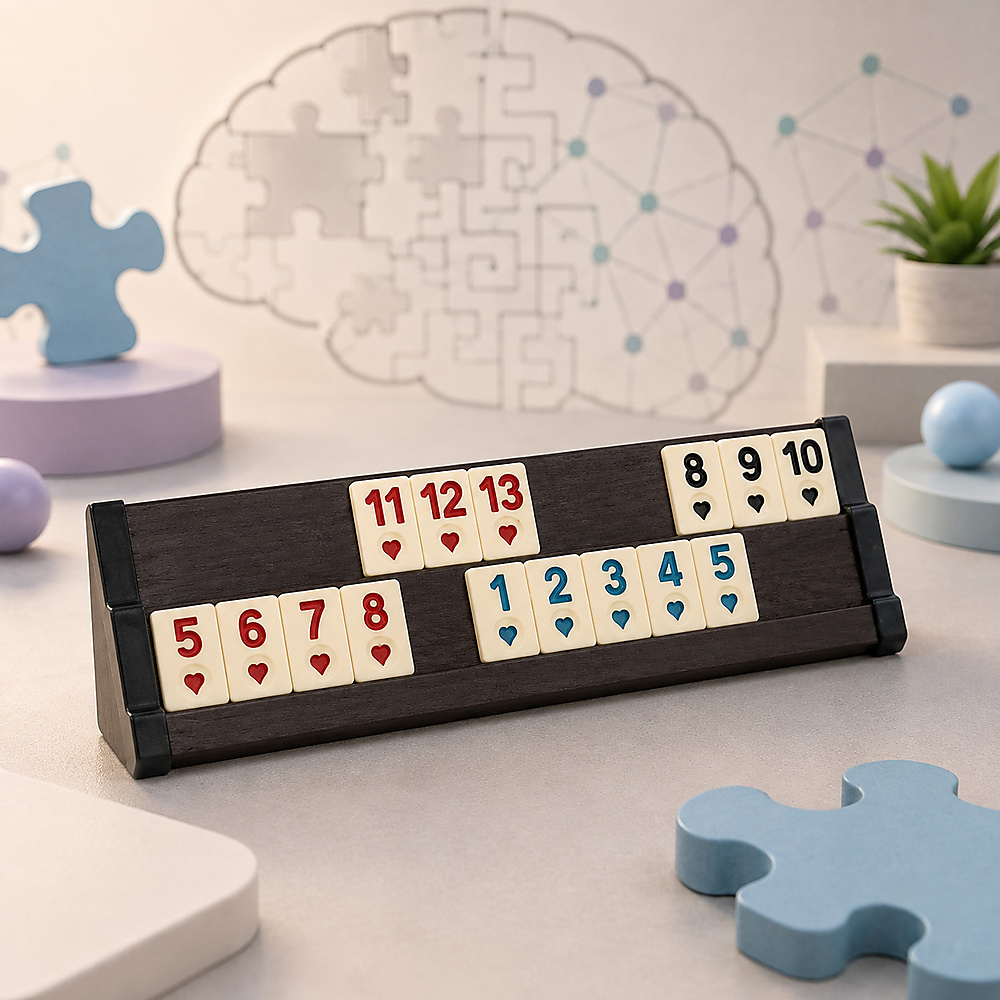
Rummikub - ok (wood)
Rumi, or the famous Turkish game of Oki, is a historical game popular in Turkey, India, and European countries.
This game is considered international and is very similar to the popular game of Hand.
How to play Rumi?
For 2 to 4 players, ages 7 and up.
Objective:
Be the first player to get rid of all their tiles by placing them in groups. Try to keep the fewest points on your rack. At the beginning of the game, you set how many points you need to reach to finish.
Contents:
106 tiles, two sets of tiles numbered from 1 to 13 in four colors: black, red, blue, and orange, and 2 jokers.
4 playing racks.
Preparation:
Place the tiles in a bag and shuffle them well. Each player chooses a tile, starting with the player with the highest number, then the next player, clockwise. Return the tiles to the bag and shuffle them well. Each player takes 14 tiles and places them on their wooden rack. Gameplay:
There are two types of sets:
Type A: A set of 3 or 4 tiles of the same number but different colors.
Type B: A set of three or more consecutive numbers, all of the same color.
The number 1 is always played as the lowest number and cannot be followed by 13.
To place tiles on the table, each player must have at least 30 points in one set or several sets.
These points must be accumulated from the player's own tiles, not from tiles on the table. The value of a tile is determined by its number. The joker can be used in place of any tile, and its value is calculated based on where it is used. The penalty for keeping the joker and having another player win is 30 points. If a player cannot participate or chooses not to participate, they must draw a tile from the draw, and their turn ends.
After players have started playing, they can also place their tiles in other players' sets on the table. If a player cannot add to the sets on the table, they take a tile from the draw to end their turn. The player cannot place the tile they drew and must wait their next turn. Play continues until one player has used up all their tiles and shouts "Rummy!" This ends the round, and players tally their points – see score. If there are no tiles left in the draw, play continues until no more tiles can be used, at which point the round ends.
Time Limit: Each player has a two-minute time limit. A player who exceeds this time must throw a tile from the draw, and their turn ends.
Incomplete Sets: A player who tries to place their tiles into other players' sets without success must return all their tiles to their original positions and draw three tiles from the draw bag. Building on Existing Combinations:
A player can build on existing combinations on the table in any of the following situations:
If there are combinations on the table that can be built on and there are no excess tiles at the end of their turn.
The Joker:
There are two jokers in the game, and they can be used in place of any tile in a combination or sequence. The value of a joker is calculated based on the value of the tile it replaces. Any player can take a joker from the table on their turn if they can replace it with the same number and color it represents on the table.
The tile used to replace the joker must come from the player's shelf, not from the table.
In the case of a combination of three identical numbers, the joker can be replaced with any of the missing colors. If a joker is taken from the table, it must be used simultaneously with at least two tiles from the player's shelf to create a new combination. A joker cannot be taken from the table if the player has not made the initial placement.
A combination containing a joker can be added to and separated. The penalty for a joker remaining on the player's shelf at the end of the game is 30 points. Strategy:
The first few rounds of play can be slow, but as you play a few sets, you'll have more opportunities to play.
Initially, it's a good idea to keep some tiles. Other players will open up the table, creating more opportunities to play.
Sometimes, it's better to keep your fourth tile and play only three. In the second round, you can play the fourth tile instead of drawing. Keeping your joker is a good move, but be aware of the risk: if another player finishes the game, you'll get 30 extra points.
Scoring:
After a player finishes all their tiles and shouts "Rummy," the other players add up the points of the tiles on their rack. These points are recorded as either negative or negative. The winning player has a positive score equal to the sum of the negative points of the other players. At the end of each round, a player adds up their positive and negative points to record the final total.
The player with the highest total at the end of the game wins.
To ensure the results are accurate, the total positive value must equal all the negative values at the end of the game. If all the tiles in the draw bag are exhausted and no player wins, the player with the lowest score on their rack is declared the winner. All other players calculate the score on their rack and record it as a negative result. They then add up all their negative scores and record the total as a positive value for the winning player. After recording, all the tiles are collected, returned to the bag, shuffled, and a new round begins. Win: The player with the highest positive score wins the game.
Price
Price On Selection
1